Case Study: The Payment Layer – A Policy and Approval Layer for AI-Agent Payments
An architectural breakdown of The Payment Layer, a policy and approval gateway engineered to enforce spending limits, isolation, and auditability on autonomous AI agents.
The Core Vulnerability: Autonomous Agents Holding Private Keys
Large language models (LLMs) operating in autonomous tool-use loops can now consume external resources independently. Instead of relying on static pre-paid API subscriptions, autonomous agents increasingly settle transactions on demand using stablecoins such as USDC, leveraging protocols like x402 (HTTP 402 Payment Required) to buy inference compute, scrape proprietary data, or query external tools.
However, provisioning an autonomous agent with direct access to an on-chain private key introduces a critical failure mode: total wallet drainage.
The Problem with Direct Key Provisioning
When an agent holds the private key to a funding wallet, any execution anomaly can liquidate available balances. Unconstrained tool-calling loops, prompt injection attacks, context window truncation, and hallucinations routinely cause agents to behave unpredictably.
A standard tool-use setup collapses two distinct operational steps into one:
- Intent generation: The LLM decides it needs to pay for a resource.
- Transaction broadcast: The runtime directly signs and broadcasts the on-chain transfer.
| Architecture | Key Custody | Failure Mode | Blast Radius |
|---|---|---|---|
| Direct Agent Wallet | Held in agent memory or environment | Loop errors, prompt injection | 100% of wallet funds drained |
| Layered Policy Intermediary | Held in an isolated signer | Blocked at evaluation phase | Zero unauthorized capital loss |
Conflating intent with execution removes all defense-in-depth. If an agent encounters an error state that triggers continuous retries, or interacts with a malicious prompt designed to divert funds to an attacker's address, the agent signs every request until the balance reaches zero.
The Payment Layer as an Enforcement Boundary
Addressing this failure requires separating payment intent from payment execution. The Payment Layer (thepaymentlayer.xyz, referred to in code as "The Layer") acts as an intermediary policy and enforcement boundary between autonomous agents and on-chain wallets.
Instead of permitting an agent to sign and broadcast transactions directly, runtime frameworks delegate payment requests to The Payment Layer. The Layer evaluates the request against deterministic, multi-stage policies before any transaction can be signed. An approved evaluation produces a cryptographic authorization—never a direct settlement. By treating an "allow" decision strictly as an authorization rather than a completed payment, The Layer ensures that autonomous systems cannot execute uninspected, unconstrained financial transactions.
Decide, Sign, Record: Separating Policy Evaluation from Execution
Autonomous agents should never hold private keys directly. When an agent needs to pay an API via an x402 header or settle an on-chain invoice, it cannot be trusted to execute arbitrary transactions. The Payment Layer enforces a hard architectural boundary: an authorization decision is strictly an "allow" signal, never a completed payment. An "allow" means the policy engine evaluated the agent's intent, confirmed the request satisfied every rule, and granted permission to proceed. It must never be confused with or worded as "paid".
The Split-System Flow
To prevent execution leakage and rogue agent transactions, the platform splits authorization from execution into four distinct phases:
- Policy Evaluation: The pure policy engine evaluates the payment request against active rules, budget limits, and risk classifications.
- Cryptographic Attestation: If permitted, the system produces a signed authorization token (a JWS) specifying the exact allowed parameters.
- Tamper-Evident Audit Logging: Before releasing the token, the authorization decision is committed to an insert-only, hash-chained audit log.
- Execution Handoff: The agent forwards the signed authorization to an isolated signing service. The signing service validates the signature, verifies the payload constraints, and only then signs the transaction using the actual wallet key.
Base-Unit Representation and BigInt Precision
Financial engineering cannot tolerate floating-point rounding errors. IEEE-754 numbers introduce fractional drift that attackers or algorithmic bugs can exploit to bypass boundary checks.
The Payment Layer enforces that financial values are represented exclusively as base-unit strings across API payloads and database records, parsed strictly as native bigint in TypeScript:
// Amounts represented strictly in atomic base units (e.g., 6 decimals for USDC)
interface PaymentIntent {
  agentId: string;
  recipient: `0x${string}`;
  asset: `0x${string}`;
  amountBaseUnits: string; // e.g., "5000000" for 5.00 USDC
}

function isWithinLimit(intentAmount: string, limitAmount: string): boolean {
  return BigInt(intentAmount) <= BigInt(limitAmount);
}
By rejecting floating-point representations entirely, precision drift and rounding truncations cannot manipulate budget calculations or drain limits.
Per-Row Environment Partitioning
Testing autonomous agents requires high transaction frequency, but test activity must never risk production assets. The platform maintains total data isolation via an explicit env column on every database record across Postgres tables (test or live).
Test-network policies, mock wallets, and Base Sepolia configurations reside in isolated tenancy domains. The engine refuses cross-environment evaluations: test credentials are explicitly denied on every mainnet network, preventing staging configurations from issuing authorizations on production rails.
The Pure Policy Engine: Deterministic Five-Stage Evaluation
The core package of The Payment Layer operates as a mathematically pure evaluation function. In systems governing autonomous financial transactions, non-deterministic policy checks introduce inconsistent state transitions and audit discrepancies. To eliminate side effects, the engine runs with zero external network I/O, zero internal clock dependencies, and zero randomness.
Rather than querying a system clock during execution, timestamps are supplied as explicit arguments. Given identical inputs—the payment intent, policy definitions, contextual records, and reference timestamp—the engine generates byte-identical outputs across any runtime. All financial calculations operate strictly on base-unit string or bigint representations, preventing floating-point precision errors.
type EvaluationResult =
  | { verdict: 'deny'; reason: string; stage: 1 | 2 | 3 }
  | { verdict: 'requires_approval'; reason: string; stage: 4 }
  | { verdict: 'allow'; stage: 5 };
The Sequential Evaluation Pipeline
Every payment request evaluates through a short-circuiting five-stage sequence. If a stage triggers a rejection or escalation, execution terminates immediately.
- Kill Switches: The engine evaluates administrative and structural blocks. It checks whether the root organization is marked as frozen, confirms the requesting agent has not been revoked, and validates that a current, non-expired policy is assigned.
- Hard Denies: The intent evaluates against static policy boundaries:
- Target recipient is on an explicit blocklist.
- Asset, destination network, or protocol is unauthorized.
- Transaction amount exceeds the absolute per-transaction maximum cap.
- Request timestamp falls outside approved operational time windows.
- Destination address matches a confirmed threat entry (such as a known drainer or exploit address).
- Dynamic Budget Limits: The engine validates the transaction against rolling spending limits across sliding daily, weekly, and monthly intervals. If the requested base-unit amount causes cumulative volume to exceed any interval ceiling, the evaluator returns a hard denial.
- Approval Routing: Transactions clearing budget thresholds are inspected for manual review triggers. Transfers directed to unverified or unknown recipients, interactions flagging suspected threat heuristics, or amounts crossing human-in-the-loop thresholds transition to an approval queue rather than failing.
- Allow Verdict: If the transaction successfully traverses all prior gates without triggering a denial or approval condition, the engine returns an
allowverdict.
An allow verdict functions strictly as an authorization grant for downstream services, not a confirmation that funds were paid.
Budget Concurrency, Threat Classifications, and Human Approvals
Concurrency Control and Atomic Budget Reservations
When autonomous agents run concurrent execution loops, asynchronous payment requests create immediate race conditions. Two simultaneous operations can inspect an available budget balance, evaluate policy constraints in parallel, and commit transactions that together exceed the configured spending ceiling.
The Payment Layer eliminates double-spending by executing the budget verification and reservation within a single PostgreSQL database transaction. The engine acquires row-level locks using SELECT ... FOR UPDATE across all active tracking windows—daily, weekly, and monthly limits. To eliminate deadlocks under high-throughput conditions, budget rows are locked in a deterministic, fixed order sorted by window timeframe:
SELECT id, spent_amount, max_amount
FROM agent_budgets
WHERE agent_id = :agent_id AND window_type IN ('day', 'week', 'month')
ORDER BY window_type ASC
FOR UPDATE;
All arithmetic is computed using integer base-unit strings and bigint types, preventing floating-point inaccuracies. If any window exceeds its ceiling, the transaction rolls back and returns a deny decision.
Threat Intelligence and Environment Isolation
Destination addresses pass through an organization-level threat classification engine before any spend decision is finalized. The system tracks six distinct risk classifications:
- Drainer: Addresses linked to automated wallet-draining scripts.
- Exploit: Contracts and wallets identified in smart contract exploits.
- Phishing: Interception sites and fraudulent interfaces.
- Scam: Deceptive counterparties and unverified token schemes.
- Mixer: On-chain obfuscation and transaction mixing protocols.
- Sanctioned: Addresses marked on official compliance watchlists.
Organizations configure action flags for each classification individually: block (immediate hard rejection), review (escalation to an operator), or off (unrestricted passage).
Environment boundaries are strictly separated: test and sandbox API keys are automatically denied on any mainnet transaction attempt, eliminating testing leakage into live settlement networks.
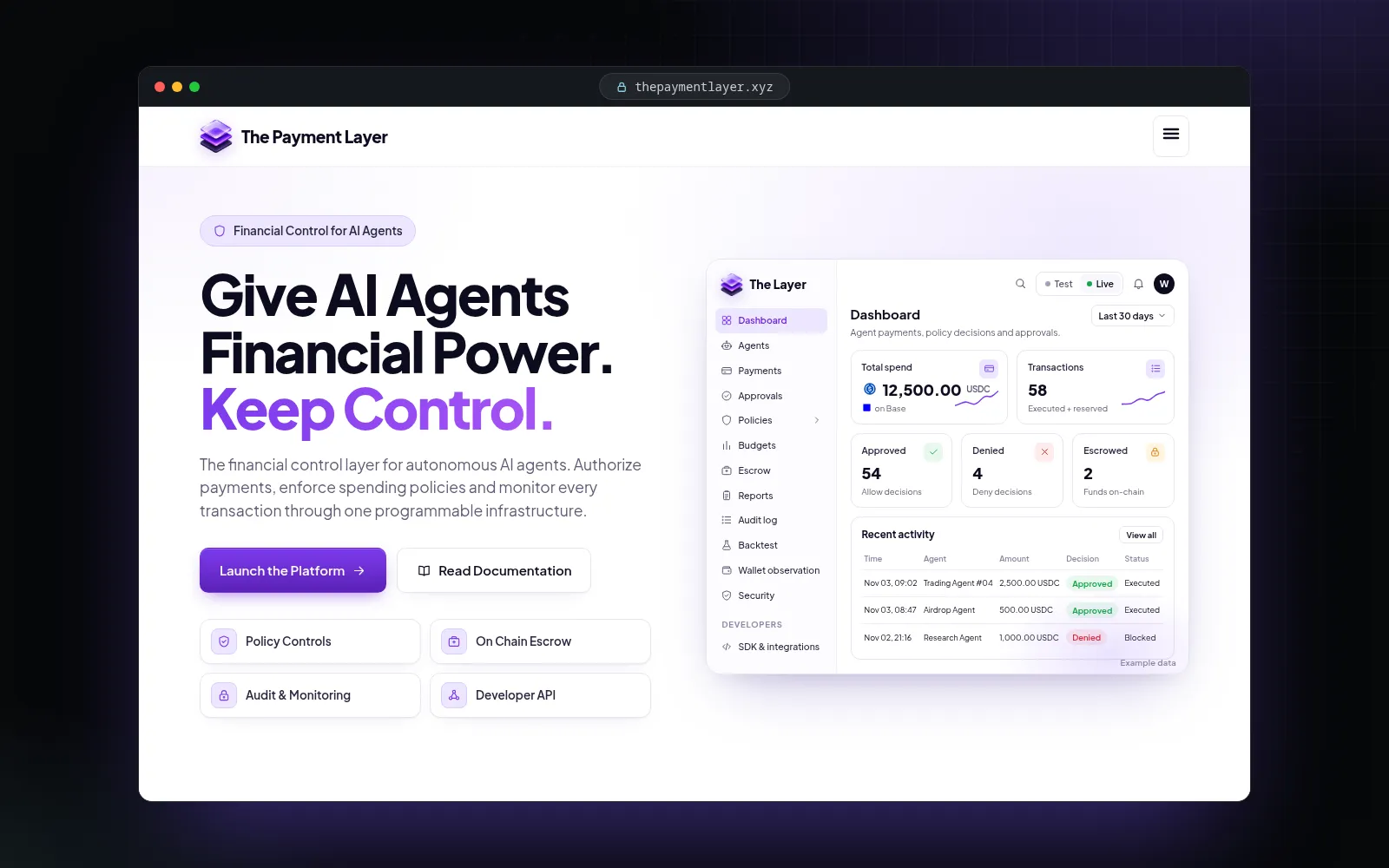
When transactions involve unlisted recipients or trigger a review flag, the engine halts automated execution and routes the intent into the human approvals queue for manual review.
Building something where money moves—agents, wallets, payments? WEB3 Build Studio builds web apps and dApps with this level of care. Fixed-scope builds start at $2,500 for a Web App or SaaS MVP and $4,000 for a Solana dApp, backed by production-first engineering.
Cryptographic Enforcers: JWS Signatures, Audit Chains, and the Isolated Signer
When the policy evaluation yields an "allow" result, The Payment Layer issues an authorization, not an executed transaction. Converting an agent payment authorization into a network-level settlement requires cryptographic isolation between policy evaluation and key storage.
JWS Decision Authorization Tokens
The evaluation engine outputs an immutable decision token formatted as a JSON Web Signature (JWS). The token is signed using Ed25519 via EdDSA exclusively; alternative signature algorithms are rejected by configuration.
The JWS payload binds the policy decision directly to the execution parameters:
- Intent Hash: A deterministic SHA-256 digest calculated over the normalized payment request (target recipient, asset address, network ID, and resource identifier).
- Expiry Window: A strict validity timestamp window preventing replay of stale authorizations.
- Bound Constraints: Explicit base-unit amount ceilings represented as strings or bigints—floating-point values are forbidden across the entire system.
Tamper-Evident Audit Chains
Every policy evaluation—whether permitted, denied, or held for human review—commits to an insert-only audit log. The underlying PostgreSQL database enforces this immutability through restrictive permissions (GRANT SELECT, INSERT) and triggers that abort any UPDATE or DELETE operations.
To guarantee log integrity, records are structured into a cryptographic hash chain calculated per organization. Each record's hash incorporates the hash of the preceding entry:
Current Record Hash = SHA-256(Current Record Payload + Previous Record Hash)
Any modification, truncation, or out-of-order insertion breaks the cryptographic continuity of the organization's chain. System secrets and credentials are shown once during creation and stored exclusively as cryptographic hashes.
Isolated Signer Architecture and Verification Rules
Autonomous agents handle untrusted data and must never hold private wallet keys. The Payment Layer isolates execution keys in a dedicated signing service running in its own standalone container (packages/signer).
When an agent requests execution—such as fulfilling an x402 payment challenge or dispatching a stablecoin transfer—it presents the JWS authorization token to the signer. Before producing a cryptographic transaction signature, the signer enforces six sequential verification invariants:
| Verification Stage | Signer Invariant Check |
|---|---|
| Signature Validity | Verifies the Ed25519 signature against the engine's public key. |
| Temporal Window | Confirms the current timestamp is within the active expiry window. |
| Intent Hash Match | Recomputes the SHA-256 digest of the transaction payload and asserts an exact match with the token's intent hash. |
| Parameter Identity | Asserts exact equality for recipient, asset, network, and resource identifiers. |
| Value Ceiling | Validates that proposed base-unit amount $\le$ authorized base-unit limit. |
| Single-Use Guard | Enforces single-use consumption: one decision token yields at most one signature. |
If any check fails, or if a token has already been marked as consumed, the signer rejects the request immediately.
Integration Adapters: Model Context Protocol (MCP) and Framework SDKs
Autonomous agents execute tasks across diverse runtime environments and agent frameworks. Rather than requiring teams to write custom middleware or handle raw authorization API payloads manually, The Payment Layer provides native adapters and a Model Context Protocol (MCP) server.
Transport-Agnostic MCP Server
The MCP package exposes policy evaluations directly to tool-calling LLMs. It operates over two standard transports:
- stdio Transport: Designed for local development loops, CLI tools, and desktop agent execution environments.
- HTTP Transport: Designed for containerized deployments, remote agent services, and distributed microservices.
Through this interface, agents discover authorization checks as standard MCP tools. The agent submits payment intent parameters—recipient address, asset identifier, network, and the exact amount in base-unit strings—to evaluate spending policies before attempting any financial execution.
Framework Adapters and SDK Distribution
The Payment Layer provides first-party integration adapters for major agentic runtimes:
- Vercel AI SDK: Native tool definitions compatible with
generateTextandstreamText. - LangChain JS: Structured tools implementing
DynamicStructuredTool. - OpenAI Agents SDK: Function schemas designed for assistant tool pipelines.
Both the TypeScript and Python SDKs are distributed directly from local workspace builds under /sdk/ rather than public registries like npm or PyPI. This distribution model matches the current test-phase status, allowing engineering teams to vendor or mount verified package builds directly within their internal codebases.
Integrating Policy Verification into Tool Pipelines
Integrating policy verification requires minimal boilerplate. In TypeScript, an agent tool wraps policy evaluation directly into the execution lifecycle:
import { paymentLayerTool } from '@thepaymentlayer/adapters-vercel';
import { z } from 'zod';

export const transferStablecoinTool = paymentLayerTool({
  name: 'transfer_stablecoin',
  description: 'Evaluate policy authorization to send stablecoins to a recipient',
  parameters: z.object({
    recipient: z.string(),
    amountBaseUnits: z.string(),
    asset: z.string(),
    network: z.string(),
  }),
  execute: async ({ recipient, amountBaseUnits, asset, network }, { decision }) => {
    if (decision.status !== 'allow') {
      return { authorized: false, status: decision.status, reason: decision.reason };
    }

    // An allow decision authorizes execution; it is not a completed payment
    return { authorized: true, decisionId: decision.id };
  },
});
By intercepting tool calls at the framework layer, engineering teams ensure agents verify policies before any downstream payment workflow begins.
Smart Contract Architecture: Escrow Caps, Verifiers, and the LayerVault
The on-chain architecture provides cryptographic enforcement and programmatic settlement controls. Built with Solidity and OpenZeppelin libraries, the system distributes responsibilities across dedicated verifiers, modular smart account execution hooks, and escrow contracts.
On-Chain Primitives
The contract suite implements three distinct components:
LayerDecisionVerifier: Validates signed decision payloads before an on-chain transaction executes. It confirms that parameters—including recipient address, network, asset, amount, and expiration—match the authorization issued by the policy layer.LayerPaymentGuardModule: Configured as an ERC-7579 execution hook for modular smart accounts. When an agent attempts an interaction, the hook intercepts the execution path and validates authorization state before the transaction can touch account balances.LayerEscrow: Segregates funds for milestone releases under strict economic boundaries.
LayerEscrow Safety Caps
To eliminate catastrophic drainage risks, LayerEscrow enforces immutable ceiling caps at the contract level:
| Parameter | Base Sepolia (Test) | Base Mainnet (Live) |
|---|---|---|
| Asset | USDC | USDC |
| Max Per Escrow | 5 USDC | 5 USDC |
| Total Escrow Cap | 100 USDC | 100 USDC |
| Limit Adjustments | Lowerable only | Lowerable only |
These constraints are written directly into the contract logic. The owner can reduce the 5 USDC per-escrow limit or the 100 USDC total limit to restrict exposure further, but the contract prevents limits from ever being increased.
LayerVault Defense-in-Depth
The LayerVault contract introduces multi-tiered access controls designed for automated treasury management:
- Dual-Key Access: Splits operational authority between an active hot owner key and an offline cold guardian key.
- Mandatory Timelocks: Whitelist additions and any policy loosening require a delay of at least 24 hours before activation.
- Asset Bounds: Enforces strict per-asset daily spending limits on all automated outflows.
- Emergency Circuit Breaker: Grants the cold guardian an instant freeze mechanism to halt all vault transfers immediately.
Deployment Status and Audit Boundary
Operational transparency requires clear delineation between live infrastructure and experimental code:
LayerVault is tested locally only. It has not been externally audited and is not deployed to Base Sepolia, Base mainnet, or any other public network. The system operates under a strict rule: customer funds are handled exclusively after an external security audit, leaving un-audited vault logic confined strictly to local development runs.
Test-Phase Realities: Test Lab, Backtesting, and Self-Hosted Operations
Deploying autonomous agent payment architectures requires strict operational boundaries before handling real-world transactions. The Payment Layer enforces conservative limits and isolated runtimes to validate deterministic evaluation without exposing production funds to risk.
The Live Test Lab
The platform operates strictly within an internal test phase using the studio's own test funds. In the Test Lab, live network transactions on Base mainnet operate under hard-coded constraints:
- Per-payment cap: Exactly 0.10 USDC.
- Daily aggregate cap: Exactly 1.00 USDC per day.
These limits allow end-to-end verification of stablecoin payments for AI agents, x402 payment headers, and signing services on a public blockchain while maintaining zero risk of catastrophic wallet drainage.
Backtesting Policy Configurations
Before assigning an agent policy to an active wallet, operators can run empirical historical validations. The backtest engine replays an on-chain wallet's historical transaction records through the deterministic five-stage evaluator. Each replayed transaction produces one of three outcomes:
- Allowed: The transaction satisfied all kill switches, deny lists, per-transaction maximums, and budget limits.
- Held: The transaction triggered an approval rule, such as an unlisted counterparty or a suspected threat classification.
- Denied: The transaction violated a strict policy rule, an asset restriction, or an absolute spending ceiling.
Every generated report explicitly notes that the result is an offline simulation, not a claim or guarantee that an actual historical loss would have been prevented in production.
Unified, Self-Hosted Deployment Stack
The Payment Layer avoids distributed message queues and complex background orchestrators to eliminate race conditions during agent payment authorization:
- Hosting: Hosted via Coolify running a single container.
- Database: PostgreSQL 16 serving the API, relational state, and insert-only, hash-chained audit records.
- Startup Lifecycle: Database migrations run automatically at container boot.
- No Message Queues: Operates with no Redis instances or background task queues.
Row-level locks in PostgreSQL execute budget checks and reservations in a single transaction, preventing concurrent double-spend attempts across simultaneous agent requests.
External Audits and Customer Capital
A strict operational rule governs the project: third-party customer funds will only be processed following a comprehensive external audit of the smart contracts and underlying signing infrastructure. Smart contracts developed for extended safety—such as the LayerVault with its dual hot-owner/cold-guardian model and 24-hour timelocks—are tested locally in development environments and are neither audited nor deployed to public networks.
Engineering Your Agent Payment Architecture
Implementing ai agent spending limits, MCP payments, and secure execution pathways requires isolating decision logic from key ownership from day one. WEB3 Build Studio designs and engineers production-ready AI systems, Web3 platforms, and custom payment infrastructure from initial architecture to live deployment.
Fixed-price product packages include:
- Web App / SaaS MVP: From $2,500 (standard builds $4,000–$7,000; pro builds from $9,000).
- Solana dApp: From $4,000.
- Monthly Hosting and Care: From $99/month for web apps and SaaS platforms on studio-managed servers with monitoring, daily backups, and ongoing maintenance.
To discuss technical specifications for your autonomous agent payment architecture, submit your project details through the project brief form or review our fixed pricing options.
Frequently Asked Questions
How does The Payment Layer enforce ai agent spending limits? The pure policy engine evaluates kill switches, transaction caps, rolling calendar budgets (daily, weekly, and monthly), and counterparty threat lists. If all stages pass, it issues a signed authorization token. Without this token, the isolated signing service will not execute the transaction.
What is the role of the backtest engine? The backtest engine replays historical on-chain wallet transactions against candidate policy sets to determine which payments would have been allowed, held for approval, or denied. Backtest results are simulations, not claims of historical loss prevention.
Can third parties process customer funds through The Payment Layer today? No. The system operates strictly in an internal test phase using the studio's own capital, capped at 0.10 USDC per payment and 1.00 USDC per day. Customer funds will only be handled after a full external security audit of the smart contracts and signing infrastructure.
Frequently asked questions
What is the operational difference between authorizing a payment and making a payment?
Authorizing a payment establishes policy compliance, budget validation, and intent before funds move. In an agent workflow, an AI agent proposes a transaction based on its objective, which an approval layer checks against constraints: spend limits, allowed recipient registries, rate limits, or required human confirmation.
Making a payment is the subsequent execution step. Once authorized, the transaction payload is signed by a secured execution engine and submitted to the settlement network—such as Solana or a traditional payment rail—to transfer the funds. Decoupling authorization from execution ensures an autonomous agent never holds direct settlement power or private keys, preventing unauthorized balance drains from prompt injection or unconstrained execution loops.
How does The Payment Layer prevent autonomous AI agents from overspending or double-spending?
The Payment Layer prevents overspending and double-spending by decoupling agent logic from fund movement through a deterministic policy engine and a stateful database. Overspending is restricted using hard caps: maximum amounts per single transaction, rolling hourly or daily budgets, and whitelist-only recipient constraints.
To eliminate double-spending and duplicate submissions from retries or agent hallucinations, each transaction requires a unique idempotency key generated by the agent or runtime. The approval layer records pending and confirmed payments in PostgreSQL via Prisma, locking state before broadcasting. If an agent emits duplicate calls or exceeds allocated budget thresholds, the policy engine rejects the request before the signing service is ever invoked.
What is the x402 payment protocol and how does a dedicated guard enforce spending constraints?
The x402 payment protocol leverages the HTTP 402 Payment Required status code to standardize machine-to-machine, pay-per-request monetization for web resources and APIs. When an agent requests a protected endpoint, the server returns an HTTP 402 response detailing the required payment, recipient, and settlement token.
A dedicated payment guard sits between the agent and the target resource as a policy proxy. Rather than allowing the agent to settle demands blindly, the guard intercepts the 402 response, verifies the requested price against configured unit limits and cumulative limits, and checks recipient authenticity. If the request conforms to the spending policy, the guard coordinates payment release; otherwise, it aborts execution.
Why must the transaction signing key be hosted in an isolated service rather than passed to the agent?
Passing transaction signing keys directly to an AI agent exposes funds to prompt injection, context leaks, and unpredictable model outputs. If a language model has raw private key access, any malicious prompt injection or execution loop can instruct the model to exfiltrate keys or drain the wallet to an external address.
Hosting signing keys in an isolated backend service enforces a zero-trust architecture. The agent only receives permission to submit unsigned payment intents to an internal API. The isolated service evaluates these intents against strict deterministic policies, database balances, and approvals. The key never enters the model context window, eliminating key theft and unauthorized transfers.
Has The Payment Layer undergone an external smart contract security audit?
No external smart contract security audit has been performed or claimed for The Payment Layer in the studio's published facts. WEB3 Build Studio builds production systems using rigorous engineering standards—including isolated signing environments, deterministic TypeScript backends, and strict policy validation—but does not state that an independent third-party audit firm has reviewed these contracts.
For production deployments involving high-value smart contracts or public token management, engaging a specialized independent security auditing firm is strongly recommended prior to mainnet launch. Note that technical specifications and architectural reviews do not constitute formal legal, security, or financial advice.
Which frameworks, agent runtimes, and client libraries are currently supported?
The Payment Layer is built around standard REST and TypeScript interfaces, making it runtime-agnostic. It natively integrates with systems built in Node.js, Next.js, and TypeScript, matching the studio's primary development stack.
Because communication relies on HTTP endpoints and structured JSON payloads, agents running on any major framework—such as custom LangChain setups, LlamaIndex, or proprietary Node.js and Python agent loops—can submit payment intents. On-chain settlement integrations are designed around Solana and standard EVM or Web3 RPCs, while data persistence is handled via PostgreSQL and Prisma. Custom client wrappers can be adapted for any environment capable of issuing secure HTTP requests to internal APIs.